
Review · ITALY
Pompeii VIP 3h Tour: Skip-the-line with your Archaeologist
Pompeii comes alive best when you can connect its cracked walls, painted rooms, shops, and body moulds to ordinary Roman life. This private three-hour tour takes you from the main entrance through the forum, temples, houses, baths, theaters, and amphitheater with an archaeologist at your side.
I like the skip-the-line entry, especially when you have limited time, and I like the route’s range. You see major public buildings, elegant homes, working spaces, the Fugitives’ Garden, and newly opened houses rather than only the famous highlights. The main drawback is the price: at $407.83 per group up to one, this is a costly choice unless the personal guide and private format matter to you.
Key points to know before booking
- New excavation finds at the antiquarium: See objects such as a coin that changed the accepted date of the eruption and a heavy gold arm cuff.
- Private archaeological guidance: You have a personal archaeologist rather than a large shared group and can ask questions along the way.
- A broad three-hour route: The visit covers the forum, temples, baths, houses, theaters, Fugitives’ Garden, gymnasium, and amphitheater.
- Recently opened houses: The route includes several homes opened to the public through newer restoration work, including the House of Golden Cupids.
- Personal tickets require identification: Every participant must provide a full name and bring an original passport or ID.
- A practical Pompeii visit: Wear good shoes, carry sunscreen, and remember that transport, food, and drinks are not included.
Why an archaeologist changes the Pompeii experience
Pompeii is not a small ruin that you can absorb in half an hour. It is a full ancient city, and its streets can blur together if you do not know what you are seeing. A specialist guide gives each stop a job in the larger picture: the forum explains civic life, the houses show private wealth, and the bakeries, markets, baths, and theaters reveal how the city worked day to day.
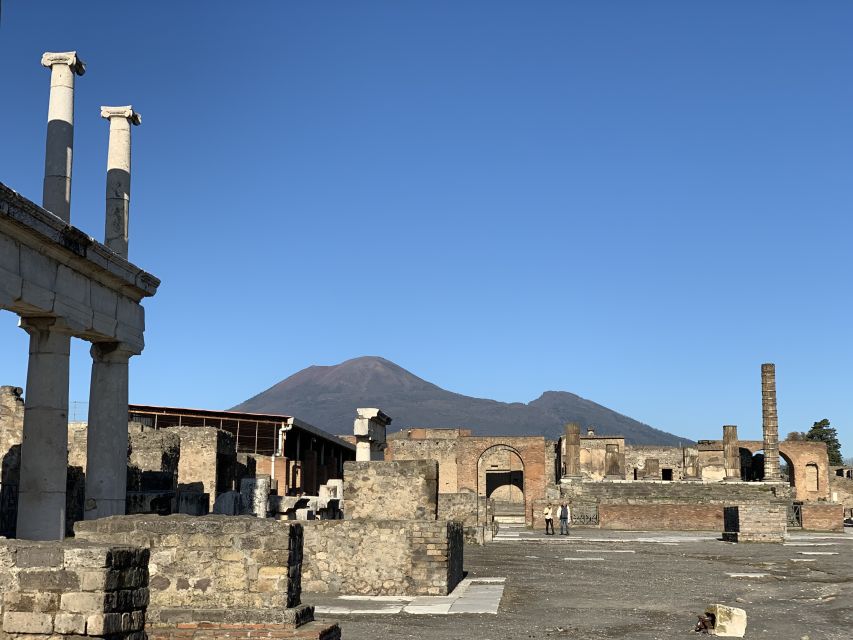
I especially like the opening at Porta Marina Superiore, where you begin close to the ancient entrance and look toward Mount Vesuvius. That view gives the visit a sharp sense of place. Pompeii is not an isolated collection of ruins. It sits beneath the volcano that buried it, and the mountain remains part of the story from the first minutes of the tour.
The guide also takes you through the antiquarium, where objects from recent excavations are displayed. A coin connected to the date of the eruption is an unusual detail, because it shows that archaeology can revise what people thought they knew. The gold arm cuff offers a different angle, pointing to personal wealth and the human scale behind the grand buildings.
Past guides connected with this experience include Ricardo, a trained archaeologist, and Federica. The exact guide for your booking may differ, but the format is designed around a specialist rather than a general escort. That distinction matters most if you like asking why a building was used, how archaeologists interpret evidence, or what restoration work can and cannot tell us.
More VIP early-access and skip-the-line tours around Italy:
- Venice: After-Hours St. Mark’s & Doge’s Palace VIP Tour
★ 4.8 · 393 reviews - VIP Colosseum Underground and Ancient Rome Small Group Tour
★ 4.5 · 332 reviews - Pisa: VIP 1.5-Hour Small Group Tour & Skip-the-Line Access
★ 4.5 · 91 reviews
Starting at Porta Marina and the Basilica
Your meeting point is Porta Marina Superiore, directly in front of the Hortus Bar. The activity begins and ends there, so you do not need to arrange a second pickup point inside the archaeological park. Transportation to Pompeii is not included, so you must make your own way to the ruins.
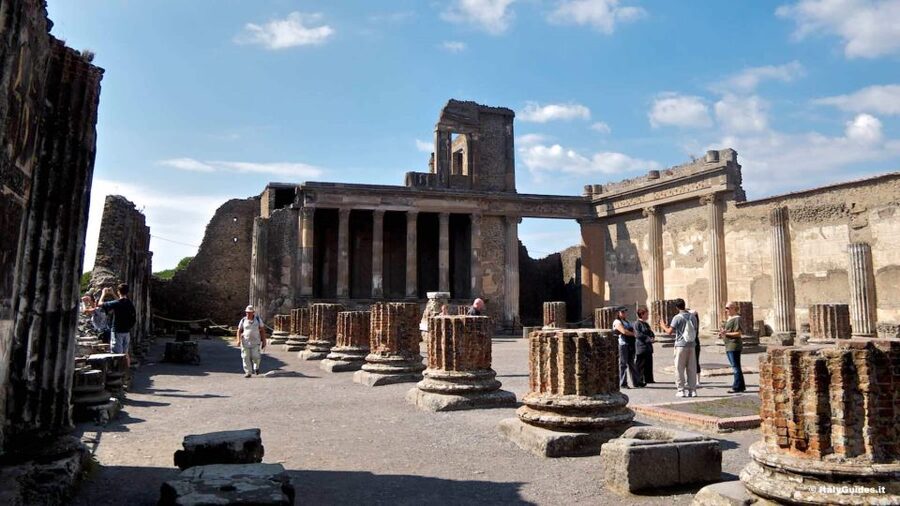
From the entrance, the route moves toward the Basilica. In Pompeii, the basilica was a major public building used for legal and commercial business. Its large scale helps you picture the city as an active Roman center, not simply a frozen town of empty walls.
This is also where a private guide earns the fee. In a group of your own, you can pause for an explanation or move on when you have had enough. The tradeoff is that the tour still has a fixed three-hour duration, so you should not expect a slow, room-by-room visit to every building.
The Forum, Apollo, and Jupiter
The Forum of Pompeii is the city’s main civic space and one of the essential stops. Here, the route brings together public life, religion, commerce, and politics. The surrounding temples and administrative buildings make more sense when you see them as parts of one central gathering place rather than separate ruins.
The Temple of Apollo adds an older religious layer to the walk. The Temple of Jupiter, at the northern end of the forum, gives the route another major sacred site and a strong view across the open square. You will probably spend much of this part of the tour looking at foundations, columns, and broad spaces, so the guide’s explanation is important.
I like this sequence because it builds a useful framework early. Once you understand the forum and its temples, the smaller streets and houses later in the tour are easier to read. The possible weakness is exposure: large open areas can be hot, and there is little point trying to rush through them just to reach the houses. Bring sunscreen and dress for comfort.
Macellum and the Forum Baths
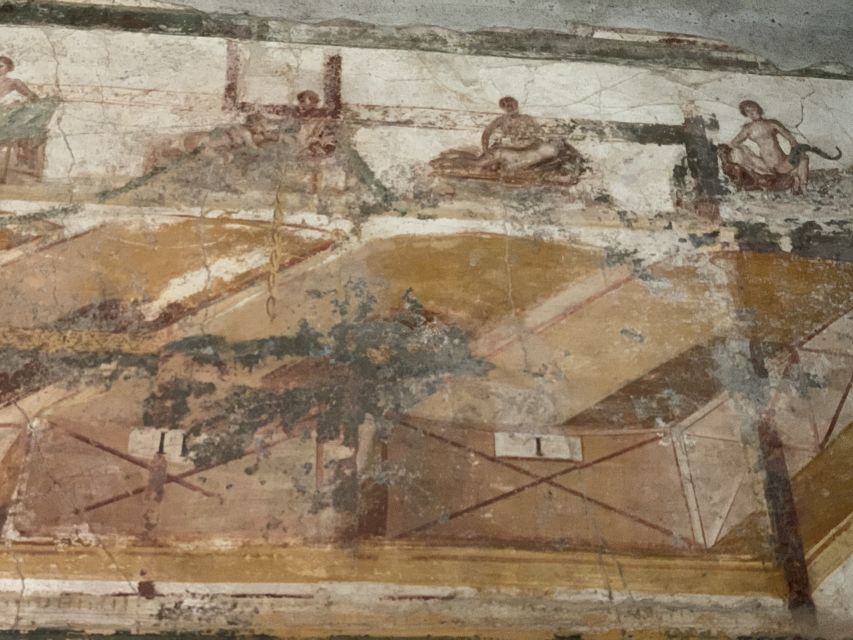
The Macellum was the city market, a place tied to food and daily trade. It gives you a change of scale after the large religious and civic buildings. Instead of imagining Pompeii only through wealthy villas, you begin to see the routines that supported ordinary urban life.
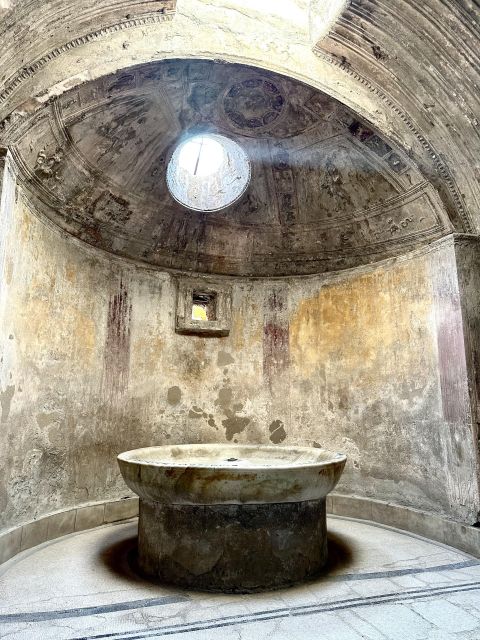
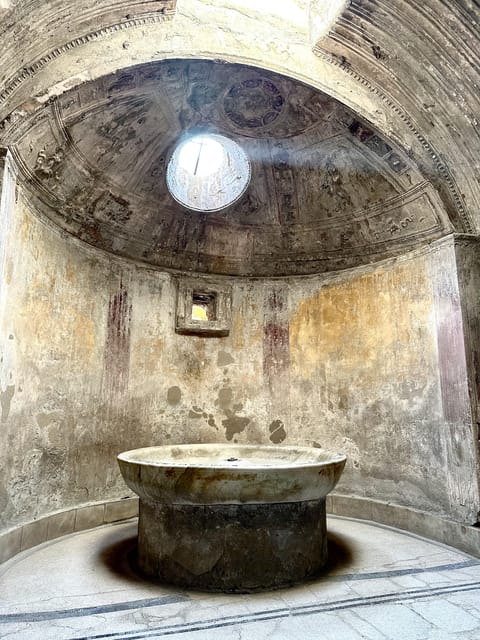
The Forum Baths show another basic part of Roman society. Bathing was not only about washing. Public baths were social and practical spaces, and their surviving rooms help you understand Roman engineering and public amenities. The tour later returns to the city’s thermal systems along the Greater Decumano, so these stops help prepare you for that larger picture.
This middle section is useful for families and first-time visitors because it keeps the focus on recognizable activities: shopping, bathing, meeting, worshipping, and conducting business. If your main goal is painted decoration or famous domestic interiors, you may find this part less visually dramatic than the houses that follow.
More three-hour treats around Italy:
- Dubai 3 Hour Private Luxury Yacht Charter with Jet Ski Option
★ 5.0 · 886 reviews - Las Vegas: 3-Hour VIP Hoover Dam Small-Group Mini Tour
★ 4.8 · 716 reviews - NYC at Night: 3-Hour Luxury Bus Tour of Top Highlights
★ 4.5 · 448 reviews - 3 Hours VIP Semiprivate Tour Isla Mujeres Full Snorkeling Experience
★ 5.0 · 404 reviews
The Greater Decumano and the Lupanare
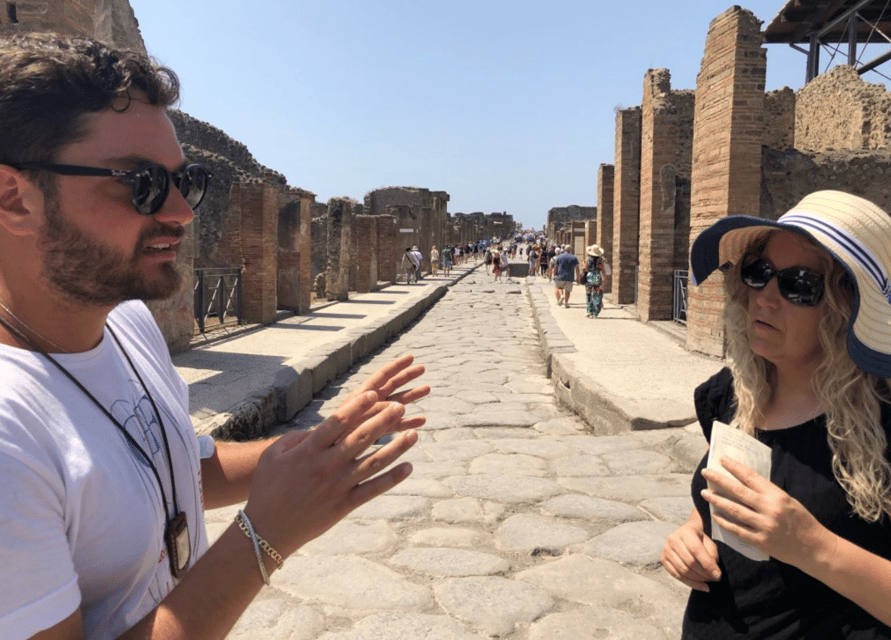
The route continues along the Greater Decumano, one of Pompeii’s principal streets. Walking a Roman street is one of the pleasures of the site. You see how doors, thresholds, drainage features, shopfronts, and public buildings met one another in a working neighborhood.
The Lupanare is among Pompeii’s best-known buildings. Its small rooms and surviving paintings offer a blunt look at commercial sex in the ancient city. This can be an interesting stop, but it may not suit every family or every child. The guide can provide context without turning the visit into a cheap joke, which is one reason a specialist is useful here.
You also look inside part of the thermal system. This is a good place to notice the practical side of Roman construction. Pompeii’s ruins are not only columns and statues. They include plumbing, heating, circulation, and carefully planned public facilities.
Pompeii’s houses and newly opened rooms
The domestic buildings are where the city often feels most personal. The route includes the House of the Tragic Poet and the House of Menander, along with other notable homes that have opened through recent restoration work. These houses let you compare different levels of wealth, taste, and household organization.
The House of Golden Cupids is a particular highlight. Its name points to the decorative details associated with the house, and restoration gives you a chance to see how archaeologists protect and present fragile rooms. Conditions can change at Pompeii, and access to individual houses may depend on park operations, so you should treat the route as a strong plan rather than a guarantee that every room will look exactly the same on the day.
The House of Menander is another important domestic stop. A private home such as this can tell you about layout and status in ways that a public monument cannot. You may find it helpful to ask the guide to explain how rooms were arranged for family life, work, receiving visitors, and display.
The advantage of seeing several houses in one visit is comparison. One villa alone can seem exceptional; several homes show you that Pompeii contained a mix of grand residences, more modest spaces, and buildings shaped by changing owners. The disadvantage is time. Three hours sounds generous, but Pompeii is large, and you will not have the freedom to linger at every mosaic or wall painting.
The Large Theatre and Pompeii’s public entertainment
The Large Theatre shifts the focus from homes and streets to entertainment. Its surviving seating and open performance space help you picture a Roman audience gathered for a public show. The guide can connect the building to the wider civic life of Pompeii, where theaters were places for leisure, status, and social contact.
This stop is especially rewarding if you like seeing how ancient buildings were designed for crowds. It also gives your feet a short mental break from looking closely at doorways and small rooms, because the scale opens up again.
Do not confuse the Large Theatre with the amphitheater at the end of the route. They served different purposes, and seeing both helps you compare Roman performance spaces. The theatre belongs to one kind of public culture; the amphitheater was built for much larger spectacles.
The Fugitives’ Garden and the body moulds
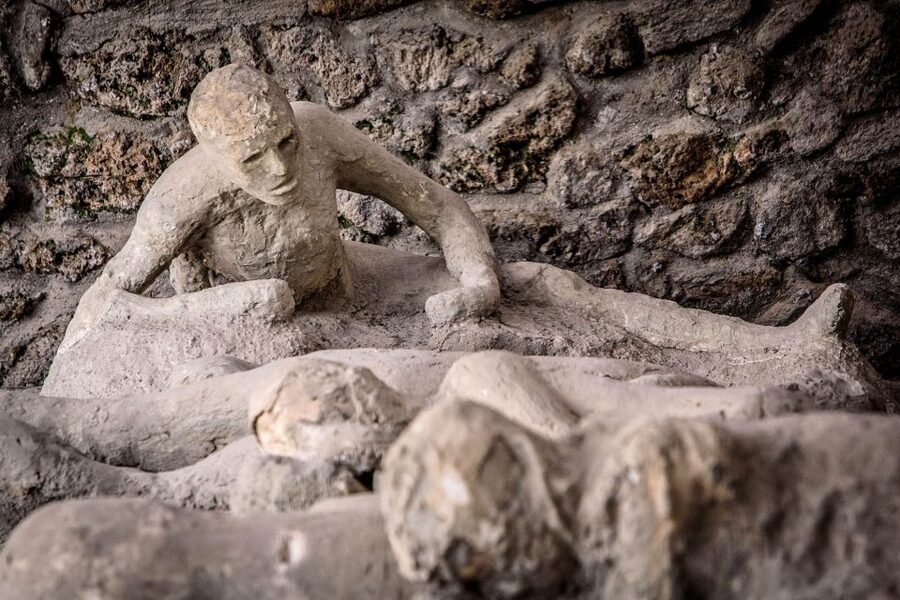
The Fugitives’ Garden is the most emotionally difficult stop. During the eruption, people tried to escape through this area but died there. The body moulds preserve the shape left by those victims, making the disaster painfully direct.
I would not treat this as just another photo stop. The moulds are powerful evidence of individual lives interrupted, and some children may find the sight upsetting. A good archaeologist can explain how the moulds were made and why they matter without stripping the moment of its human weight.
This is also where the tour’s title, built around the last days of Pompeii, becomes more than a slogan. You have already seen markets, baths, houses, and theaters. Here, you confront the people who occupied that city when normal life ended.
The Great Gymnasium and the final amphitheater
The Great Gymnasium is the last major stop before the amphitheater. Objects from daily life are displayed here, giving you another chance to move beyond monuments and focus on tools, belongings, and ordinary routines. After the emotional weight of the Fugitives’ Garden, this stop brings the visit back to the material world of the city.
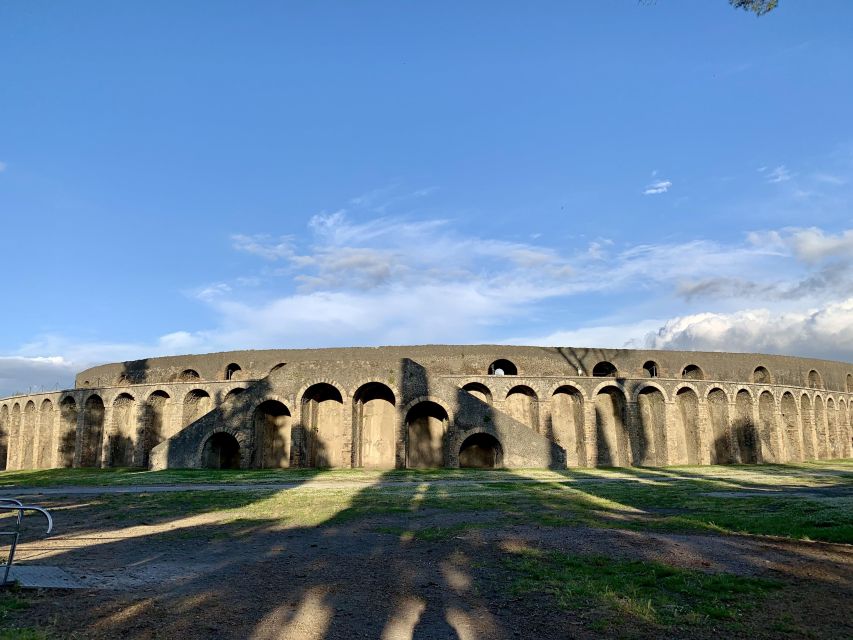
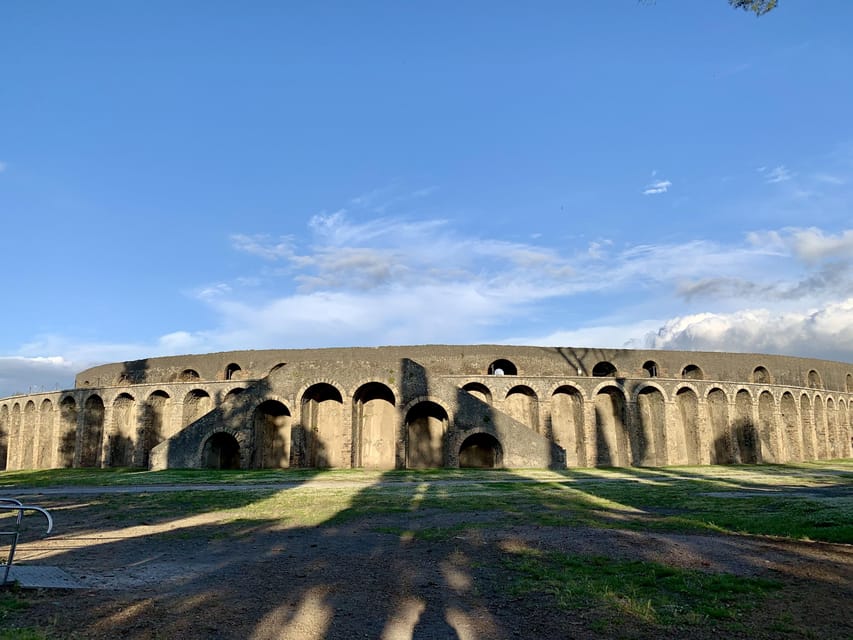
The Amphitheater of Pompeii closes the route. It is one of the most recognizable buildings in the archaeological park, and its size gives you a strong final impression of Pompeii as a city built for large public events. Ending here works well because the tour finishes with a structure that gathers the public scale, engineering, and social life you have seen throughout the morning.
You then return to the Pompeii ruins meeting point. Since the tour ends where it starts, you can continue exploring independently, find food nearby, or make your onward arrangements. Those extra plans are up to you and are not part of the experience.
Is $407.83 good value for three hours?
The listed cost is $407.83 per group up to one, which places this firmly in the premium category. Admission, skip-the-line service, private guiding, and full assistance are included, but transportation, food, and drinks are not.
The value depends on what you need. If you are visiting Pompeii once, have only three hours, and want an archaeologist to shape the visit around the city’s major sites, the price can make sense. Skip-the-line entry also protects your limited sightseeing time, while the private format avoids the pace and distractions of a large group.
If you are comfortable reading the site independently, have a full day, or are watching every euro, the cost is harder to justify. Pompeii is large enough that you could spend more time there on your own, though you would lose the built-in explanation and direct access to a specialist.
The unusual wording of the price, per group up to one, is worth checking carefully before payment. Confirm how the booking handles the number of people in your party so you are not surprised by the final total.
Practical details that can make or break the visit
Wear comfortable shoes. Pompeii involves a great deal of walking over ancient streets and uneven surfaces, so footwear matters more than dressing up for the occasion.
Bring sunscreen and wear comfortable clothes. Much of the route is outdoors, and the open forum, streets, and amphitheater can leave you exposed to the sun.
The tour is offered in English, French, Spanish, and Italian. It is also wheelchair accessible, though the archaeological setting may still require careful pacing. If accessibility is important for your party, confirm the current route and conditions when booking.
Every participant, including children, must provide a full first and last name for the ticket. Bring an original passport or ID, and arrive on time because the tickets are personal. Pets, alcohol, and drugs are not allowed.
You can cancel up to 24 hours in advance for a full refund, and the reserve-now, pay-later option gives you some flexibility. Starting times depend on availability, so check the schedule before building your Pompeii day around it.
Who should book this Pompeii tour?
I would choose this for a first visit when you want the main city explained in a logical order and do not want to spend time waiting at the entrance. It suits couples, families, and small private parties who value direct access to an archaeologist and want to ask plenty of questions.
It is also a good fit if you care about both famous sights and newer discoveries. The antiquarium, restored houses, House of Golden Cupids, daily objects, and body moulds give the tour more range than a quick forum-and-amphitheater visit.
I would look elsewhere if your priority is low cost, a very slow study of art and architecture, or independent wandering. Three hours gives you an excellent overview, but Pompeii is too large for any short tour to cover every corner.
FAQ
How long is the Pompeii VIP tour?
The guided experience lasts three hours. Starting times depend on availability.
Where does the tour begin?
You meet at Porta Marina Superiore, directly in front of the Hortus Bar.
Where does the tour end?
The activity ends back at the Pompeii ruins meeting point.
Are admission tickets included?
Yes. Admission tickets and skip-the-line service are included.
Is transportation included?
No. You must arrange your own transportation to and from Pompeii. Food and drinks are also not included.
Which languages are available?
The tour is offered in English, French, Spanish, and Italian.
Do I need to bring identification?
Yes. Pompeii requires the full name and surname of every participant, including children. Bring an original ID or passport, and arrive on time because the tickets are personal.
Is the tour wheelchair accessible?
Yes, the activity is listed as wheelchair accessible.
Should you book it?
Book this tour if you want Pompeii organized around the most important public buildings, houses, daily-life spaces, and eruption evidence, all with a private archaeologist and no ticket-line wait. The strongest reasons are the specialist guidance, the newly opened houses, and the chance to connect the forum and villas with the human tragedy shown at the Fugitives’ Garden.
Skip it if the price is too high for your budget or you prefer a full day of independent exploration. For everyone else, this is a focused way to see a very large site without reducing Pompeii to a quick look at the forum and amphitheater.
New VIP and luxury tours around Italy
- Luxury Shared Boat Tour in Polignano a Mare with Local Aperitif★ 5.0 · 30 reviews
- Polignano a Mare luxury boat tour, aperitif, diving and snorkeling★ 5.0 · 51 reviews
- PRIVATE ARGILLARIUM EXPERIENCE RITUS OTIUM – CONSACRATIO 150 min★ 5.0 · 39 reviews
- Luxury Amalfi Coast Boat Tour with Swim & Prosecco – Small Group★ 5.0 · 18 reviews
- Full day luxury trip around Amalfi Coast and Capri★ 5.0 · 12 reviews
- Amalfi Coast Private Boat Tour – Luxury Experience★ 5.0 · 13 reviews
- Jackie Kennedy Amalfi Coast Private Tour (Vintage Car & Boat) VIP EXCLUSIVE★ 5.0 · 6 reviews
- Full day luxury trip around Amalfi Coast★ 5.0 · 7 reviews
More of the best Italy Luxury Tours

Legendary Venice: Doge’s Palace, St Mark’s & VIP Terrace Access
Read our review →
Rome: Colosseum Arena, Roman Forum & Palatine Hill VIP Tour
Read our review →
VIP Vatican Breakfast and Guided Tour with Sistine Chapel Access
Read our review →
Colosseum, Roman Forum & Palatine Hill Guided Tour
Read our review →
VIP Vatican, Sistine Chapel & St. Peter’s Basilica Guided Tour
Read our review →
From Naples – VIP Tour with small groups on the Amalfi Coast
Read our review →
Luxury catamaran from Porto Rafael-Palau to the Maddalena Archipelago
Read our review →
Rome Catacombs & Capuchin Crypts VIP Group Tour with Transfers
Read our review →Lists this tour is ranked in